Everything you need to know about knee replacement surgery
Published May 2026
Expert contributor: Dr Samuel Duff, orthopaedic surgeon
Words by Angela Tufvesson
Struggling with knee pain? Before you think about knee replacement surgery, get all the facts here.
Knee pain can affect your work, hobbies and everyday life. Many Australians turn to surgery for relief – in 2024, nearly 80,000 knee replacements were performed across the country, a number that’s been rising steadily over the past decade. But how do you know if surgery is really the right move for you?
Here, we answer some of the most common questions about knee replacement surgery, including who might need it, what the procedure involves and alternative treatments.
What is knee replacement surgery?
Your knee is the largest joint in your body, connecting your thigh bone to your shin bone. It supports your weight (including everything you carry) and all your movements, from walking and bending to running and climbing. It's no wonder it can become injured – it has to work hard.
A knee replacement is when your damaged knee joint is replaced with a new, artificial one. It can reduce pain, improve your flexibility and help you be more active.
“It replaces the worn cartilage with a metal and highly engineered plastic surface,” says orthopaedic surgeon Dr Samuel Duff.
You might have a partial (or unicompartmental) knee replacement, where only the damaged part of the knee joint is replaced, or a total knee replacement, which replaces the whole joint.
What conditions does a knee replacement treat?
Knee replacements are used to treat severe, chronic pain that affects daily life and doesn’t go away with other treatments. For example, you might have trouble walking, climbing stairs or getting up out of a chair.
Dr Duff says severe osteoarthritis – an ongoing condition where your joints can become painful and stiff – is the most common reason for knee replacement surgery. It can also be used to replace a knee joint affected by other conditions like rheumatoid arthritis or haemophilia.
About 50% of people who experience a serious knee injury will develop osteoarthritis within 10 years. According to the Australian Physiotherapy Association, Australia has one of the world’s highest and fastest-growing rates of serious knee injuries.
Is there an alternative to knee replacement surgery?
It’s worth keeping in mind there may be other options to try before you go down the surgical route. Depending on your diagnosis, other forms of treatment to reduce knee pain and help maintain mobility may include:
- weight management
- exercise and physical activity
- physiotherapy
- pain medications
- non-steroidal anti-inflammatory drugs (NSAIDs)
- corticosteroid injections into the joint
- mechanical aids like walking frames or sticks.
If you experience knee pain and are an RT Health member, you may be able to access dietitian and exercise physiology services, as well as physiotherapy, through your extras cover.
How do you know if you need a knee replacement?
Most people who need a knee replacement have tried other treatments like low-impact exercise, physiotherapy and weight management that haven’t worked.
However, Dr Duff says a knee replacement isn’t always the last resort. “It depends on the severity of the symptoms and the arthritis. We prefer not to wait until someone is so deconditioned that they don’t do as well from eventual knee replacement,” he says.
Can you be ‘too young’ or ‘too old’ for knee replacement?
Dr Duff says knee replacements are usually most common and effective between the ages of 55 and 85. He adds that setting realistic expectations is the key to a good outcome.
“A knee replacement is not a perfect knee,” he says. “It’s not a running knee or a cross-country skiing knee. It’s a good solution for a worn-out knee.”
What’s knee replacement recovery like?
Recovering from knee replacement surgery is a long process. Most people leave hospital one to four days after surgery. You’ll usually take painkillers for three to four weeks and be on crutches for four to six weeks, Dr Duff explains.
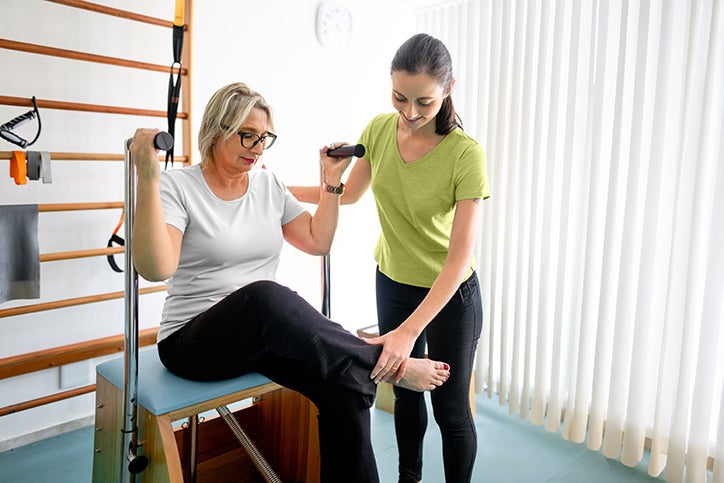
An exercise and physiotherapy program will help you regain flexibility and strength in your knee. Eligible RT Health members can receive rehab treatments at home when they can be given safely and at the same or better quality than in hospital.
Dr Duff says total knee replacement recovery time is usually around nine months. “Most people are ready to walk the equivalent of a golf course type distance at about three months after the procedure,” he says. “And they’re probably ready for an overseas holiday around four months after they’ve had it done.”
How long does a knee replacement last?
According to a large study published in The Lancet, 82% of total knee replacements will last as long as 25 years. Dr Duff says if you have a knee replacement when you’re between 55 and 65, the chance of it lasting at least 20 years is 89%.
Regular check-ups, ongoing rehab and maintaining a healthy weight can help maintain durability.
What does knee replacement surgery cost?
If you have private health cover, the cost of knee replacement in private hospital settings typically incurs an out-of-pocket cost of about $1,000, as well as any hospital fees.
While there are no costs of having knee replacement in a public hospital, waiting times are an important consideration. The median waiting time for a total knee replacement in a public hospital was 255 days in between 2024 and 2025.
Does RT Health cover knee replacement surgery?
Check your hospital cover guide or get in touch with us directly to find out what’s included in your cover.
Still have questions?
If you’ve got knee pain and are looking for treatment options, our Member Care team can answer any questions you have. Give them a call on 1300 886 123 or get in touch via email to help@rthealth.com.au
This wellbeing message is brought to you by the team at RT Health, a division of HCF, The Hospitals Contribution Fund of Australia Limited (ACN 000 026 746). This communication contains information which is copyright to HCF. It should not be copied, disclosed or distributed without the authority of HCF. Except as required by law, we do not represent, warrant and/or guarantee that this communication is free from errors, virus, interception or interference. All reasonable efforts have been taken to ensure the accuracy of material contained on our website. It’s not intended that this website be comprehensive or render advice. The information provided on this website is general information only and may not be suitable to your individual circumstances or health needs. Please check with your health professional before making any dietary, medical or other health decisions as a result of reading this website.